
Specimen
Wels catfish
Silurus glanis
How to identify
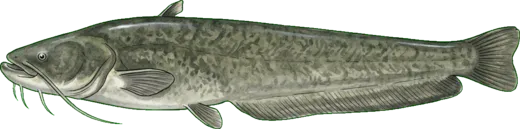
Huge scaleless fish with a broad flat head, a wide mouth, two long whiskers on the top jaw and four short ones below, a tiny dorsal fin and a long anal fin running to the tail. Mottled dark olive to black.
Easily confused with
Nothing else in UK freshwater looks like it; small ones are sometimes mistaken for eels or bullheads.
Habitat
Warm, rich stillwaters, mostly specialist and commercial lakes stocked under licence. Most active at night and in warm weather.
Where in the UK & Ireland
A non-native species found only in licensed stillwaters in England and Wales, for example estate lakes, gravel pits and specialist "cat" waters in the Midlands, East Anglia and the South East.
Season & close season
Best from late spring to early autumn when water is warm, especially at night; slow in winter.
Best baits
Large halibut pellets, fish or squid deadbaits, worms in bunches, and big boilies on the right waters.
Rigs & methods
Bolt-rig ledgering with strong hooklinks, or float-legered baits at night; pre-baiting areas with pellets.
Tackle
Strong 2.75-3.5 lb test curve rods, 20 lb+ mainline, abrasion-resistant hooklinks, large strong hooks, an unhooking mat large enough for the fish, and a large landing net.
Watercraft
Look for features in the margins, snags and deep areas close in. Fish into darkness on warm, overcast nights after a spell of settled weather.
Conservation & the law
Wels may only be kept in waters holding the right permit under the Keeping and Introduction of Live Fish rules; never move them. Not present in Ireland, where it is not permitted.
Rod Race tip
Choose a commercial lake that publicises its catfish stock and fish a halibut pellet at night in summer.
How the Rod Race works →Where to catch wels catfish
No venues have reported this species yet.
Also likely at many lakes — see them on the map.
Recent catches
None logged yet.