
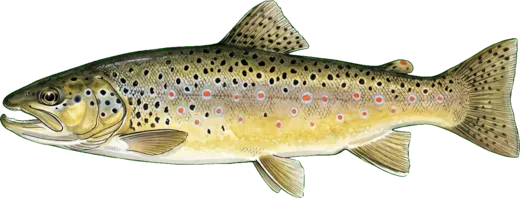
Game
Trout
Salmo trutta
How to identify
Golden-brown to olive flanks covered in black and red spots, often with pale haloes; small fleshy adipose fin between the dorsal fin and tail; square-ish tail. Colour varies hugely with habitat, from silver lake fish to buttery river fish.
Easily confused with
Sea trout (the same species after a spell at sea: silver, few spots, slightly forked tail), rainbow trout (pink lateral band, spots on the tail) and young salmon (parr: slimmer wrist, more forked tail, fewer red spots).
Habitat
Clean, cool, well-oxygenated water: chalk streams, freestone and spate rivers, upland becks, lochs, loughs and llyns, plus stocked trout stillwaters.
Where in the UK & Ireland
Found throughout the UK and Ireland. Famous waters include the Hampshire chalk streams (Test, Itchen), the Derbyshire Dove and Wye, Welsh rivers such as the Usk, Teifi and Dee, the Scottish lochs and the great Irish loughs (Corrib, Mask, Sheelin, Melvin).
Season & close season
Brown trout have a statutory close season on rivers that varies by region: in England and Wales it usually runs from early October to March (exact dates differ between regions and fisheries); in Scotland it is 7 October to 14 March; in Ireland seasons vary by fishery district. Many stocked stillwaters fish all year.
Best baits
Artificial flies (dry flies, nymphs, wet flies, streamers); where the fishery rules allow, worms and small spinners.
Rigs & methods
Upstream dry fly and nymph on rivers; wet fly and loch-style drifting from boats on lochs and loughs; Czech/French nymphing in fast water; small spinners on spate rivers where permitted.
Tackle
A 7-9 ft #3-5 fly rod for rivers and a 9-10 ft #5-7 for stillwaters and boats; 3-6 lb tippet; barbless hooks where required.
Watercraft
Fish upstream so trout facing into the current do not see you. Look for rises in the creases where fast water meets slow, under overhanging trees and at the tails of pools. Hatches often peak late morning and at dusk.
Conservation & the law
Many rivers are fly only and catch-and-release; check the permit. Do not move live fish between waters. Rainbow trout are a separate, stocked species. In England and Wales anglers aged 13+ need a rod licence (Environment Agency / Natural Resources Wales) as well as permission from the fishery.
Rod Race tip
A stocked trout stillwater gives you a quick tick; a wild brown from a stream is the purist's version. Book a day ticket and fish a small nymph or a buzzer under an indicator.
How the Rod Race works →Where to catch trout
Reported at reported
LakeAltnahinch
Ballycastle, Northern Ireland
RiverAnnacloy River
Downpatrick, Northern Ireland
LakeBallykeel Lough Erne
Ballynahinch, Northern Ireland
RiverBallymoney River
Ballymoney, Northern Ireland
RiverBallynahinch River
Ballynahinch, Northern Ireland
LakeBewl Water, Kent
Kent, England
LakeBinevenagh Lake
Limavady, Northern Ireland
LakeBlagdon Lake, Somerset
Somerset, England
 Lake
Blessington Lakes, Wicklow
Wicklow, Ireland
LakeBrantry Lough
Dungannon, Northern Ireland
RiverCarey River
Ballycastle, Northern Ireland
LakeCarsington Water, Derbyshire
Derbyshire, England
LakeCastlewellan Forest Lake
Castlewellan, Northern Ireland
LakeChew Valley Lake, Somerset
Somerset, England
LakeClatworthy Reservoir, Somerset
Somerset, England
 River
Colebrooke River
Lisnaskea, Northern Ireland
LakeConiston Water, Cumbria
Cumbria, England
LakeCopeland Reservoir
Carrickfergus, Northern Ireland
LakeCorranny Lake
Clones, Northern Ireland
LakeCraigavon City Park Lake - North
Craigavon, Northern Ireland
LakeCreevy Lough
Saintfield, Northern Ireland
LakeDraycote Water, Warwickshire
Warwickshire, England
LakeDungonnell Reservoir
Ballymena, Northern Ireland
LakeEyebrook Reservoir, Leicestershire
Leicestershire, England
Rivers & canals where it's likely likely (3,859 waters)
River Thames
near Greenwich, England · 378 km
River Shannon
near Drumshanbo, Ireland · 357 km
River Severn
near Much Wenlock, England · 307 km
River Trent
near Gainsborough, England · 287 km
River Avon
near Tidworth, England · 262 km
River Usk
near Usk, Wales · 220 km
River Stour
near Gillingham, England · 196 km
River Great Ouse
near Stony Stratford, England · 192 km
River Suir
near Cahir, Ireland · 182 km
River Avon
near Pershore, England · 176 km
River Barrow
near Monasterevin, Ireland · 170 km
River Spey
near Kingussie, Scotland · 168 km
River Nene
near Wellingborough, England · 168 km
River Wye
near Ross-on-Wye, England · 167 km
River Blackwater
near Millstreet, Ireland · 165 km
River Erne
near Cavan, Ireland · 163 km
River Tweed
near Innerleithen, Scotland · 161 km
River Tame
near Lichfield, England · 160 km
River Tees
near Darlington, England · 152 km
River Dee
near Ballater, Scotland · 148 km
River Welland
near Stamford, England · 142 km
River Aire
near Farsley, England · 140 km
River Clyde
near Lanark, Scotland · 137 km
Grand Canal
near Edenderry, Ireland · 133 km
Also likely at many lakes, rivers — see them on the map.
Recent catches
None logged yet.