
Game
Grayling
Thymallus thymallus
How to identify
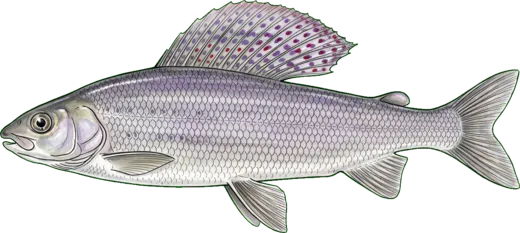
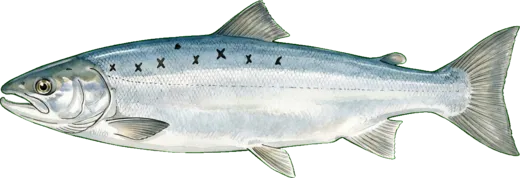
Silver-grey fish with a large, sail-like dorsal fin (purple and red-tinged), a small down-turned mouth, small dark spots on the flanks and an adipose fin. Fresh fish smell faintly of thyme.
Easily confused with
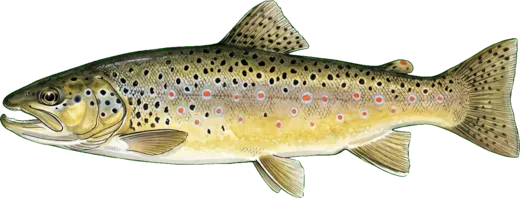
Trout (spotted, no sail fin), dace (no adipose fin).
Habitat
Clean, cool, well-oxygenated rivers with gravel; often in shoals in steady glides.
Where in the UK & Ireland
English chalk streams (Test, Itchen, Wylye, Kennet), Welsh rivers (Wye, Usk, Dee, Teme), Yorkshire and northern rivers (Ure, Swale, Wharfe, Eden), and southern Scottish rivers (Tweed, Clyde, Tay). Not present in Ireland.
Season & close season
In England and Wales grayling follow the coarse close season (15 March to 15 June). Best in autumn and winter, which is when trout fishing is closed.
Best baits
Maggots, red worms, small nymphs (pink shrimps, Czech nymphs), dry flies in summer.
Rigs & methods
Trotting a stick float with maggots; Czech or French nymphing; dry fly fishing on warm days.
Tackle
13 ft float rod with 2-3 lb line, or a 9-10 ft #3-4 nymphing fly rod.
Watercraft
Grayling hold in shoals in even-paced glides over gravel. Trot your bait close to the bottom. Return them quickly, as they are sensitive to handling.
Conservation & the law
Many fisheries require barbless hooks and catch-and-release. Check river rules. In England and Wales anglers aged 13+ need a rod licence (Environment Agency / Natural Resources Wales) as well as permission from the fishery.
Rod Race tip
Trot a maggot down a chalk stream or northern river glide in late autumn.
How the Rod Race works →Where to catch grayling
Reported at reported
 River
Hampshire Avon, Ringwood
Ringwood, England
 Lake
Llyn Tegid (Bala Lake), Gwynedd
Gwynedd, Wales
 River
River Clyde, Lanark
Lanark, Scotland
 River
River Dee, Llangollen
Llangollen, Wales
RiverRiver Dove, Derbyshire
Derbyshire, England
RiverRiver Eden, Cumbria
Cumbria, England
RiverRiver Frome, Dorset
Dorset, England
RiverRiver Itchen, Winchester
Winchester, England
RiverRiver Kennet, Hungerford
Hungerford, England
RiverRiver Nidd, Knaresborough
Knaresborough, England
RiverRiver Tay, Dunkeld
Dunkeld, Scotland
RiverRiver Teme, Ludlow
Ludlow, England
RiverRiver Test, Stockbridge
Stockbridge, England
RiverRiver Tweed, Kelso
Kelso, Scotland
RiverRiver Ure, Ripon
Ripon, England
RiverRiver Wharfe, Wetherby
Wetherby, England
RiverRiver Wye, Bakewell
Bakewell, England
RiverRiver Wye, Hay-on-Wye
Hay-on-Wye, Wales
Rivers & canals where it's likely likely (63 waters)
River Severn
near Much Wenlock, England · 307 km
River Trent
near Gainsborough, England · 287 km
River Usk
near Usk, Wales · 220 km
River Wye
near Ross-on-Wye, England · 167 km
River Tweed
near Innerleithen, Scotland · 161 km
River Tees
near Darlington, England · 152 km
River Clyde
near Lanark, Scotland · 137 km
River Teme
near Ludlow, England · 129 km
River Eden
near Penrith, England · 125 km
River Wharfe
near Otley, England · 124 km
River Derwent
near Scarborough, England · 122 km
River Ure
near Ripon, England · 118 km
River Swale
near Northallerton, England · 116 km
River Dee
near Wrexham, Wales · 115 km
River Test
near Stockbridge, England · 114 km
River Wear
near Durham, England · 111 km
River Severn
near Montgomery, Wales · 107 km
River Ribble
near Barnoldswick, England · 106 km
River Derwent
near Darley Dale, England · 105 km
River Tamar
near Launceston, England · 103 km
River Exe
near Bampton, England · 99 km
River Kennet
near Marlborough, England · 98 km
River Wye
near Llandrindod, Wales · 96 km
River Nith
near Thornhill, Scotland · 90 km
Recent catches
None logged yet.