
Predator
Eel
Anguilla anguilla
How to identify
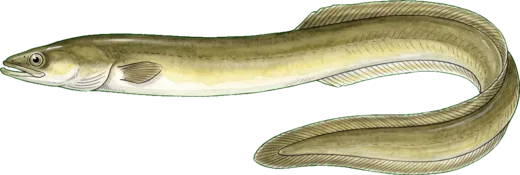
Long snake-like body, slimy skin with tiny embedded scales, small pectoral fins, and one continuous fin around the tail. Lower jaw slightly longer than the upper.
Easily confused with
Lampreys (no jaws, sucker mouth, no pectoral fins), small wels catfish.
Habitat
Almost every kind of freshwater, from ditches and canals to big lakes and rivers; most active at night in warm months.
Where in the UK & Ireland
Throughout the UK and Ireland, though numbers have crashed since the 1980s.
Season & close season
Summer nights are best; often caught by accident on worm or meat baits. River fishing follows the coarse close season in England and Wales.
Best baits
Worms (lobworms), small deadbaits, fish strips.
Rigs & methods
Ledgered worm or deadbait with free-running rigs and a quick strike so the hook is in the lip, not swallowed.
Tackle
10-12 lb line, a wire or strong trace, size 4-8 hooks, a large net and a damp towel or mat for handling.
Watercraft
Warm thundery nights after rain are the classic eel conditions. Fish near snags and margins.
Conservation & the law
The European eel is critically endangered. All eels caught must be returned alive in England and Wales, and eel retention is banned in Ireland. Return every eel you catch quickly and carefully.
Rod Race tip
Fish a lobworm at night in summer on a canal or lake and strike early; return it straight away.
How the Rod Race works →Where to catch eel
No venues have reported this species yet.
Rivers & canals where it's likely likely (4,161 waters)
River Thames
near Greenwich, England · 378 km
River Shannon
near Drumshanbo, Ireland · 357 km
River Severn
near Much Wenlock, England · 307 km
River Trent
near Gainsborough, England · 287 km
River Avon
near Tidworth, England · 262 km
River Usk
near Usk, Wales · 220 km
Leeds and Liverpool Canal
near Brierfield, England · 207 km
River Stour
near Gillingham, England · 196 km
River Great Ouse
near Stony Stratford, England · 192 km
River Suir
near Cahir, Ireland · 182 km
River Avon
near Pershore, England · 176 km
River Barrow
near Monasterevin, Ireland · 170 km
River Spey
near Kingussie, Scotland · 168 km
River Nene
near Wellingborough, England · 168 km
River Wye
near Ross-on-Wye, England · 167 km
River Blackwater
near Millstreet, Ireland · 165 km
River Erne
near Cavan, Ireland · 163 km
River Tweed
near Innerleithen, Scotland · 161 km
River Tame
near Lichfield, England · 160 km
River Tees
near Darlington, England · 152 km
River Dee
near Ballater, Scotland · 148 km
River Welland
near Stamford, England · 142 km
River Aire
near Farsley, England · 140 km
River Clyde
near Lanark, Scotland · 137 km
Also likely at many lakes, rivers, canals — see them on the map.
Recent catches
None logged yet.