
Game
Arctic char
Salvelinus alpinus
How to identify
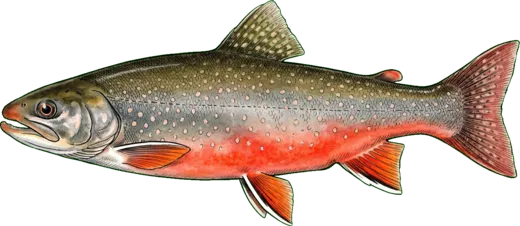
A trout-like fish with an adipose fin, tiny scales, pale cream spots on a darker background (trout have dark spots on a light background) and, in breeding colours, a bright red-orange belly and white leading edges to the lower fins.
Easily confused with
Brown trout and brook trout (brook trout have wormy marbling on the back).
Habitat
A glacial relic that needs deep, cold, clean lakes. Lives deep in summer and comes shallower in winter.
Where in the UK & Ireland
English Lake District (Windermere, Coniston, Ennerdale, Haweswater, Buttermere), Welsh llyns (Padarn, Peris, Bodlyn, where it is called torgoch), many Scottish lochs (Rannoch, Ericht, Awe, Loch Insh and others) and some Irish loughs.
Season & close season
Usually follows the trout season for the lake; some Lake District char are traditionally fished from spring to autumn by plumb-lining.
Best baits
Small spinners and spoons, small flies; on the Lake District, traditional char spinners on plumb lines.
Rigs & methods
Trolling small spinners deep from a boat (traditional plumb-lining with weighted lines), or fly fishing at dusk when char rise. Use an echo sounder to find the depth they are holding at.
Tackle
Light trolling outfit or a 9 ft #5-6 fly rod with sinking lines; 4-6 lb line.
Watercraft
In summer the char sit below the warm surface layer (thermocline), often 15-30 m down. Calm evenings can bring them up to feed.
Conservation & the law
Several populations are vulnerable and some are protected; many fisheries ask for all char to be returned. Check the lake rules before fishing.
Rod Race tip
Book a boat or a guide on Windermere or a Scottish char loch and troll deep through the day.
How the Rod Race works →Where to catch arctic char
No venues have reported this species yet.
Recent catches
None logged yet.